In the dynamic world of construction materials, gypsum board has emerged as a cornerstone due to its versatility, fire resistance, and ease of installation. As a leading gypsum board production line supplier, we’ve witnessed firsthand the transformative power of plastering machines in this process. In this blog, I’ll delve into the pivotal role of plastering machines in a gypsum board production line. Gypsum Board Production Line
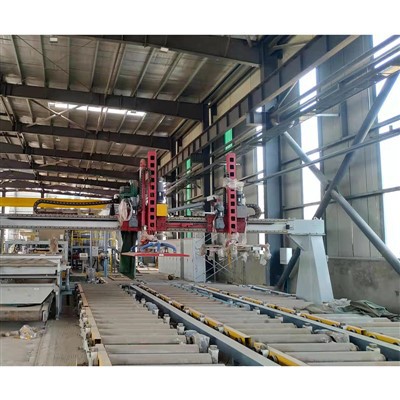
The Basics of Gypsum Board Production
Before we explore the role of plastering machines, it’s essential to understand the overall gypsum board production process. It begins with the extraction of gypsum from mines. The raw gypsum is then crushed and heated to remove excess water, transforming it into a powder known as stucco. This stucco is then mixed with water, additives, and other materials to form a slurry. The slurry is spread between two layers of paper, which act as the facing material for the gypsum board. After the slurry sets, the board is cut to the desired size and dried in a kiln.
The Role of Plastering Machines
1. Slurry Preparation and Mixing
The plastering machine is the heart of the gypsum board production line when it comes to slurry preparation. These machines are designed to mix the stucco, water, and additives in precise proportions. The accuracy of this mixing process is crucial as it directly affects the quality of the gypsum board. A well – mixed slurry ensures uniform density and strength throughout the board.
Modern plastering machines are equipped with advanced mixing technologies. They can handle large volumes of materials efficiently, ensuring a continuous supply of high – quality slurry. The mixing process is also automated, which reduces the risk of human error and ensures consistent results. For example, some machines use high – speed agitators to break down any lumps in the slurry, ensuring a smooth and homogeneous mixture.
2. Slurry Application
Once the slurry is prepared, the plastering machine is responsible for applying it evenly between the two layers of paper. This is a critical step as the thickness and uniformity of the slurry layer determine the final quality of the gypsum board.
Plastering machines use various techniques to apply the slurry. Some machines use a spreading mechanism that evenly distributes the slurry across the width of the paper. Others use a spraying system, which can provide a more precise and controlled application. The speed and pressure of the application can be adjusted according to the requirements of the production line, ensuring that the slurry is applied at the right thickness and with the right consistency.
3. Quality Control
Plastering machines play a vital role in quality control during the gypsum board production process. They are equipped with sensors and monitoring systems that can detect any irregularities in the slurry application. For example, if the slurry thickness is not uniform, the machine can automatically adjust the application parameters to correct the problem.
These machines also help in maintaining the right temperature and humidity during the slurry application process. The temperature and humidity can affect the setting time of the slurry, and by controlling these factors, the plastering machine ensures that the gypsum board sets properly and has the desired strength and durability.
4. Increased Productivity
One of the most significant advantages of using a plastering machine in a gypsum board production line is the increase in productivity. These machines can work continuously for long periods, producing a large number of gypsum boards in a short time.
Compared to manual plastering, which is time – consuming and labor – intensive, a plastering machine can significantly reduce the production time and cost. It can also handle large – scale production, making it suitable for industrial – level gypsum board manufacturing.
5. Cost – Effectiveness
In the long run, using a plastering machine in a gypsum board production line is cost – effective. Although the initial investment in a plastering machine may be high, the savings in labor costs and the increase in productivity make it a worthwhile investment.
The machine reduces the need for a large workforce, which not only saves on labor costs but also reduces the risk of human error. Additionally, the consistent quality of the gypsum boards produced by the plastering machine can lead to fewer rejects, further reducing costs.
Technological Advancements in Plastering Machines
Over the years, there have been significant technological advancements in plastering machines. These advancements have made the machines more efficient, reliable, and user – friendly.
1. Automation
Modern plastering machines are highly automated. They can be programmed to perform various tasks, such as mixing, application, and quality control. This automation reduces the need for manual intervention, which not only increases productivity but also improves the accuracy and consistency of the production process.
2. Remote Monitoring
Many plastering machines now come with remote monitoring capabilities. This allows operators to monitor the machine’s performance and status from a remote location. They can also receive real – time alerts if there are any issues with the machine, enabling them to take immediate action.
3. Energy Efficiency
With the growing concern for environmental sustainability, plastering machines are being designed to be more energy – efficient. They use advanced technologies to reduce energy consumption without compromising on performance. For example, some machines use variable – speed drives to adjust the power consumption according to the workload.
Challenges and Solutions
While plastering machines offer many benefits, there are also some challenges associated with their use in a gypsum board production line.
1. Maintenance
Plastering machines require regular maintenance to ensure their optimal performance. This includes cleaning, lubrication, and replacement of worn – out parts. To address this challenge, we provide comprehensive maintenance training to our customers and offer spare parts and technical support.
2. Compatibility
Ensuring the compatibility of the plastering machine with other components of the production line is crucial. We work closely with our customers to understand their specific requirements and design the plastering machine to be fully compatible with their existing production line.
3. Training
Operating a plastering machine requires specialized skills. We offer training programs to our customers to ensure that their operators are well – trained and can operate the machine safely and efficiently.
Conclusion

In conclusion, the plastering machine plays a crucial role in a gypsum board production line. It is responsible for slurry preparation, application, quality control, and increasing productivity. With the continuous technological advancements, plastering machines are becoming more efficient, reliable, and user – friendly.
High-strength Calcium Silicate Board Production Line If you’re in the market for a gypsum board production line or looking to upgrade your existing equipment, we’re here to help. Our team of experts can provide you with the best solutions tailored to your specific needs. Contact us today to start a discussion about your requirements and explore how our plastering machines can enhance your gypsum board production process.
References
- "Gypsum Board Manufacturing Technology" – Industry report on gypsum board production processes.
- "Advances in Plastering Machine Technology" – Research paper on the latest developments in plastering machines.
- "Quality Control in Gypsum Board Production" – Academic study on ensuring high – quality gypsum board production.
Shineye Mach Co., Ltd.
Shineye Mach Co., Ltd. is one of the most reliable manufacturers and suppliers of gypsum board production line in China, also supports customized service with reasonable price. Please feel free to buy advanced gypsum board production line made in China here from our factory. For quotation, contact us now.
Address: Jinzhou Circular Industry Park, Jinzhou City, Shijiazhuang City, Hebei Province, China
E-mail: xiangyijixielucia@yeah.net
WebSite: https://www.shineyemach.com/
